Cocoa schools, 1880 through integration in 1968
From the first one-room school in 1880 through the long parallel system of Black schools (Monroe High, Roosevelt) and white schools (Cocoa High), to the federal court order that desegregated Brevard County schools in 1968-69.
Cocoa’s school history is in two parts that have to be told together: the white public schools, which grew from a single one-room building in 1880 into Cocoa High School (founded 1925) and a network of elementary schools; and the Black schools, which operated under the separate-but-equal regime from the late 1880s through 1968. The Black school system, built around Monroe High School (officially Roosevelt-Monroe after a 1949 consolidation), served the Black communities of Cocoa, Rockledge, and Merritt Island and produced multiple generations of teachers, professionals, and civic leaders despite chronic underfunding by the Brevard County School Board.
Brevard County integrated its public schools under federal court order in 1968-69, fourteen years after Brown v. Board of Education and as late as any school district in Florida that wasn’t sued individually.
The first schools, 1880-1900
The earliest documented school in Cocoa was a private one-room subscription school operated around 1879-1881 by Mrs. R.C. May, the wife of one of the founding settlers. Families paid roughly $2 per child per month. Instruction was through the 8th grade level, with no formal curriculum.
The first public school in Cocoa opened in 1888, two years after Florida established the public school system under the 1885 state constitution. The building was a one-room frame schoolhouse on Forrest Avenue, with a single teacher and an enrollment of 23 students. Records of the Brevard County School Board, preserved at the Brevard Public Schools archives, show similar schools opening in Rockledge (1889), Eau Gallie (1891), and Merritt Island (1895).
The Black school in Cocoa opened in 1894. It was housed initially in a wood-frame building on what is now King Street, paid for in part by the Black community’s own fundraising, a common pattern in Reconstruction-era and post-Reconstruction Florida, where the state school fund formally supported Black schools but allocated dramatically less per pupil than to white schools. Florida Department of Education funding data for 1900 shows Brevard County spending about $24 per white pupil versus about $7 per Black pupil.
Cocoa High School, founded 1925
The first dedicated high school building in Cocoa opened in 1925 as Cocoa High School, on the site now occupied by Cocoa Junior/Senior High. The original 1925 structure burned in a 1936 fire; the replacement building, completed 1937 in the WPA-era brick style, is partly still standing as the central wing of the current Cocoa High School campus.
Cocoa High served the city’s white population from 1925 through 1968. Enrollment grew from about 180 in 1925 to roughly 900 by the early 1960s. The school’s football tradition dates from this era; the first state championship in football came in 1939.
Curriculum followed the standard Florida public high school program: English, history, math through algebra and geometry, biology, Latin (until the 1950s), and physical education. The school added vocational tracks in the 1940s, primarily auto shop and home economics.
Monroe High School and the Black school system
The principal Black secondary school in Cocoa was Monroe High School, founded in 1923 and named for Monroe James Wilson, an early Black educator in Brevard County. Monroe High was a combined junior-senior high school serving Black students from Cocoa, Rockledge, and the smaller Black communities along the lagoon.
In 1949 Monroe High consolidated with Roosevelt Elementary (the principal Black elementary school in Cocoa) to form what was officially Roosevelt-Monroe but was usually called Monroe by everyone except school administrators. The combined K-12 facility was located on Stone Street, in the heart of the Black community west of US-1.
Monroe High graduated its last segregated class in 1968. The building continued to operate as Monroe Junior High after integration, then was eventually closed and the campus repurposed.
Alumni of Monroe High include several figures of regional and state prominence: educators who returned to teach in integrated Brevard schools after 1968, military veterans who served in World War II and Korea before returning to citrus-economy jobs, and the small professional class (ministers, undertakers, small-business owners) that supported the Black community through the segregation era.
The under-resourcing of Monroe relative to Cocoa High was documented in NAACP-filed school equalization lawsuits in the late 1940s and 1950s. Per-pupil spending, teacher salaries, textbook quality, and athletic facilities all lagged. The Brevard County School Board, like most Southern school boards of the era, attempted to demonstrate “equality” by building newer Black school facilities in the 1950s when Brown v. Board litigation threatened, the school equalization scramble, but the spending gap remained substantial through the final segregated year.
The 1968 integration
The federal court order desegregating Brevard County public schools was issued in 1968 under a consolidated case originating in Florida federal district court. Brevard had been operating under a “freedom of choice” plan from 1965 to 1968 that nominally allowed Black students to enroll in white schools but produced minimal actual integration, only about 4% of Black students had transferred to formerly-white schools by 1967.
The 1968 order required full integration starting with the 1968-69 school year, achieved through pupil reassignment and the closure or repurposing of several Black school buildings. Monroe High closed as a high school. Roosevelt-Monroe Junior High continued for a few years as an integrated junior high before that campus too was closed.
Cocoa High absorbed Monroe’s former students starting with the 1968-69 academic year. The integration was largely peaceful by the standards of the era, there were no documented violent incidents at Cocoa High in 1968 or 1969, but it was not uneventful. Black teachers from Monroe were displaced; several were not rehired by Brevard County and left teaching. White flight to Catholic and Episcopalian private schools in Cocoa Beach and Rockledge increased modestly through the 1970s. Cocoa High’s enrollment briefly dipped in 1969-70 before stabilizing.
What followed
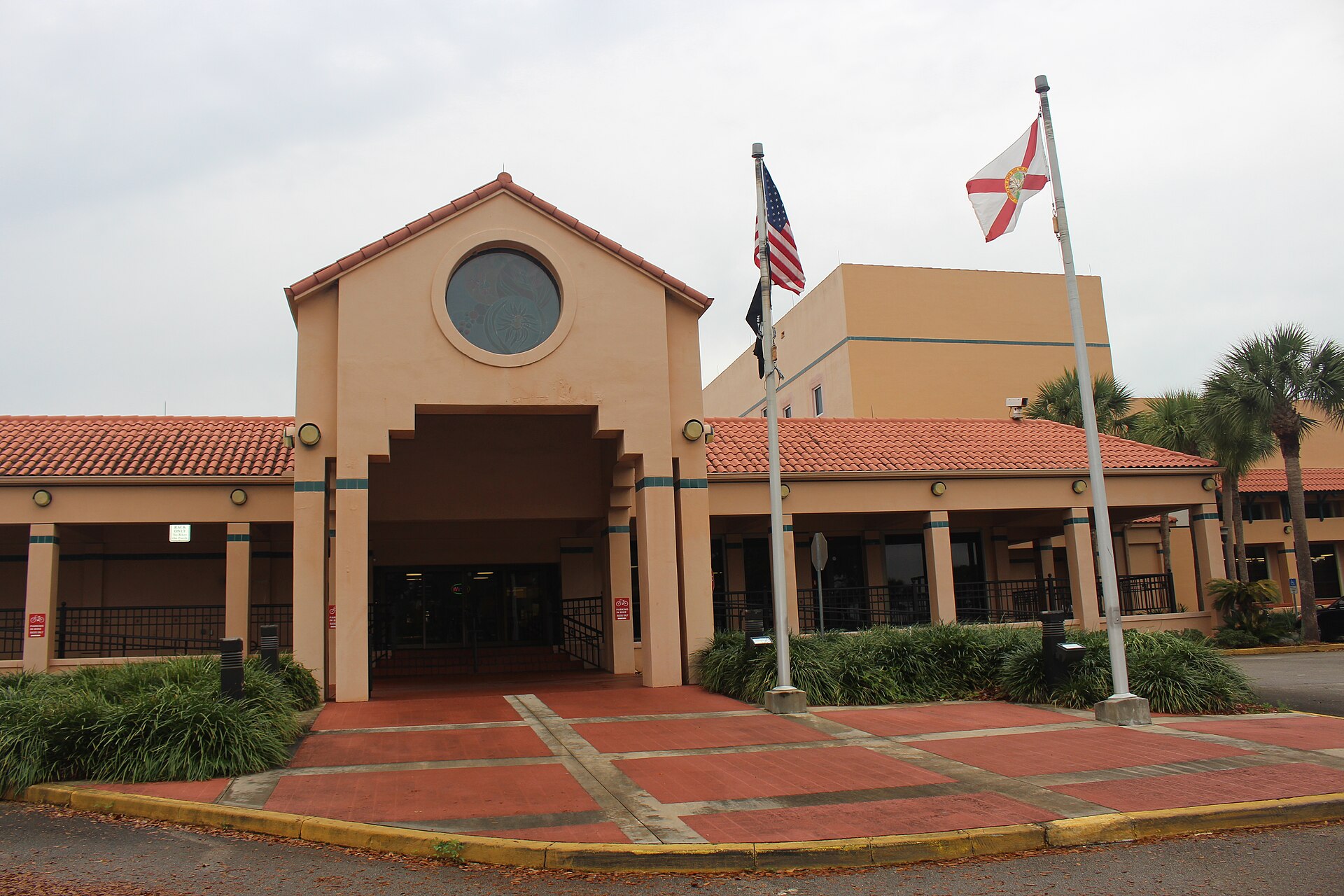
By 1980 Cocoa High was a fully integrated comprehensive high school. The 1937 building was supplemented by additions in 1960, 1972, and 1996. The current Cocoa Junior/Senior High School campus serves Cocoa, parts of Rockledge, and parts of Merritt Island.
The Monroe High legacy is preserved through the Monroe High School Alumni Association, which holds annual reunions and maintains historical records of the school’s 45-year operation. A small historical marker stands on the former Monroe campus site.
The Brevard School Board’s own institutional history has, in the past decade, more honestly engaged with the segregation-era record. Public-facing materials acknowledge the funding disparities and the late integration date. This is recent. For most of the post-1968 period the official narrative was “Brevard integrated peacefully and on schedule,” which is partially true and partially a softening.
What’s still standing
The 1937 Cocoa High School brick wing is still in use as part of the current campus. Some of the original interior detailing survives, terrazzo floors, transom windows over the classroom doors, the original auditorium woodwork.
The Roosevelt-Monroe campus on Stone Street is gone. The site is now occupied by a community center and recreational fields. A historical marker installed in 2005 names the school and its founding date.
Further Reading
- Before His Time: The Untold Story of Harry T. Moore by Ben Green
- Florida: A Short History by Michael Gannon
Sources
- Brevard Public Schools, district historical records, Office of the Superintendent.
- Florida Department of Education, historical statistics on public school funding by county and race, 1885–1968.
- NAACP Legal Defense Fund, school equalization case files, Florida cases, 1940s–1960s, via Library of Congress.
- Cocoa Tribune and Florida Today, school coverage 1925–1975.
- Monroe High School Alumni Association historical records.
- U.S. Census, Brevard County educational attainment data, 1900–1970 decennial.
- Federal court records, U.S. District Court for the Middle District of Florida, Brevard County school desegregation case, 1968.
- Florida State Archives, Department of Public Instruction records, Brevard County School Board files.
As an Amazon Associate we earn from qualifying purchases.